How Much Is Your Junk Car Worth in Ontario in 2026? 7 Factors That Affect Its Value
If you have an old, damaged, or non-running vehicle, you may be wondering: how much is my scrap car worth in Ontario? The answer depends on several factors, including your vehicle's weight, condition, make and model, recyclable materials, and demand for reusable parts.
Understanding your junk car value in Ontario can help you compare offers and make a more informed decision before selling your vehicle. Whether your car has been sitting in your driveway for years or has recently been written off after an accident, it may still have value.
In this guide, we explain the seven main factors that affect junk car prices in Ontario in 2026, what you can expect from a scrap car offer, and how to get a competitive quote.
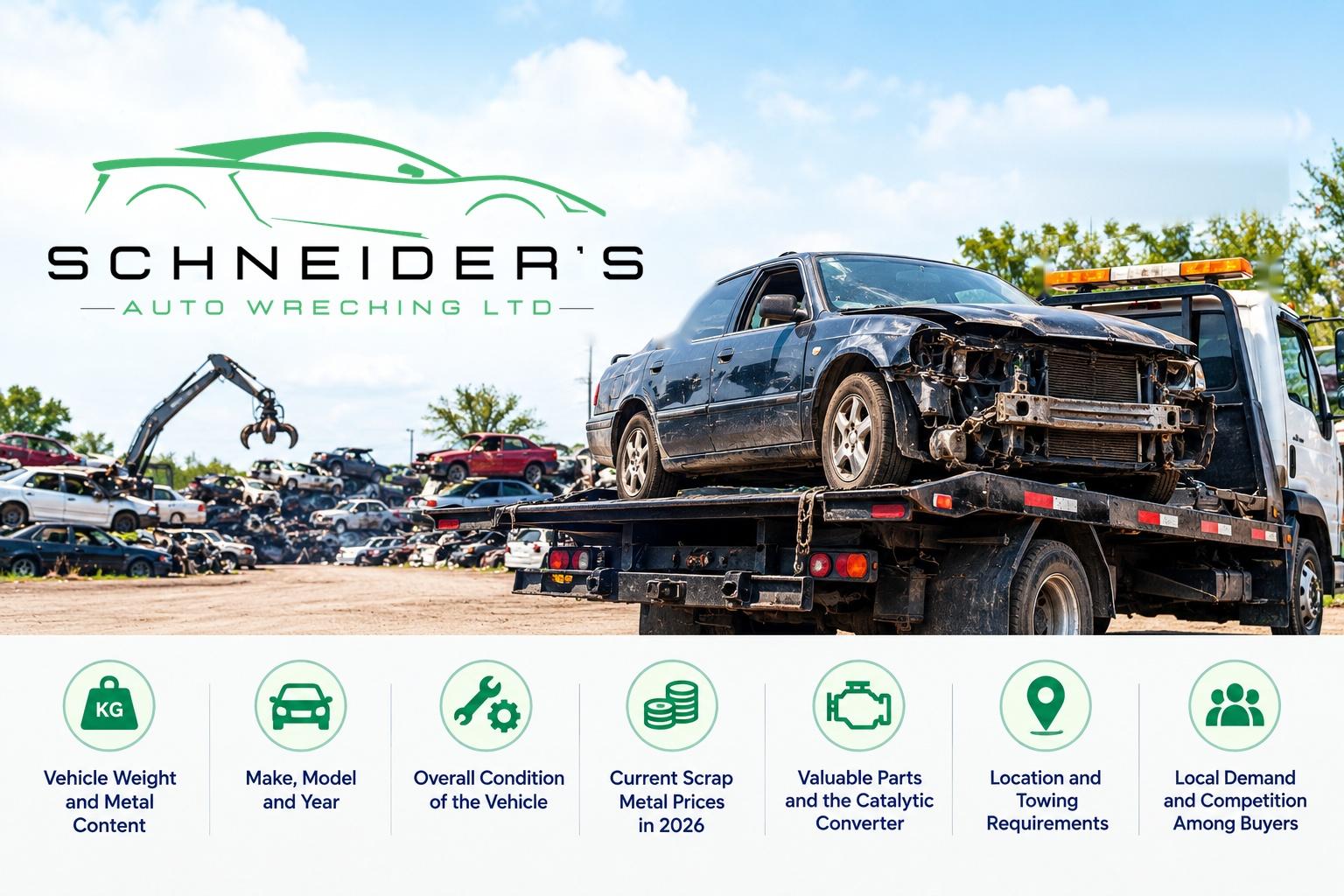
Table of Contents
How Much Is a Junk Car Worth in Ontario in 2026?
In 2026, scrap car prices vary significantly depending on the vehicle and the buyer. Canadian pricing guides publish broad estimates ranging from a few hundred dollars for many passenger vehicles to over $1,000 for some larger SUVs and trucks. These figures are estimates, not guaranteed payouts.
The following ranges are illustrative estimates for Ontario, based on published 2026 pricing guidance. Your actual offer may fall outside them.
| Vehicle type | Indicative estimated value (CAD) |
|---|---|
| Compact car | $200–$500 |
| Midsize sedan | $250–$600 |
| Full-size sedan | $300–$700 |
| Compact SUV | $300–$650 |
| Minivan | $350–$750 |
| Full-size pickup truck | $400–$850 |
| Full-size SUV | $450–$1,000 |
*Source: ScrapHub's 2026 Canadian scrap-car pricing guide. Ranges vary by vehicle, completeness, market conditions, and local buyer. They should not be treated as current offers or guaranteed prices.*
A complete vehicle with desirable reusable components may receive a stronger offer than a stripped vehicle of similar weight. Similarly, a vehicle that is easy to collect may be more attractive to a local buyer.
The best way to establish your scrap car value in Ontario is to request current quotes from multiple reputable auto recyclers like Schneider’s Auto Wrecking.
7 Factors That Affect Junk Car Value in Ontario
1. Vehicle Weight and Size
Vehicle weight is one of the main factors affecting scrap value because end-of-life vehicles contain recyclable steel, aluminium, copper, and other materials.
Generally, larger vehicles contain more recyclable material than smaller cars. This is why a pickup truck, van, or full-size SUV may receive a higher scrap offer than a compact sedan.
However, weight is only part of the calculation. The condition of the vehicle and the value of its remaining components can also influence the final amount.
How to improve your offer: Provide the correct year, make, model, and trim so the recycler can identify the vehicle and estimate its material content accurately.
2. Current Scrap Metal Prices
Scrap metal markets change over time, affecting the amount recyclers can recover from end-of-life vehicles.
Steel accounts for a substantial portion of most cars, while aluminium and copper can also contribute to recycling value. When market prices rise, the underlying value of recyclable materials may increase. When prices fall, buyers may adjust their offers.
This is why scrap car prices in 2026 may differ from prices offered in previous years or even earlier months.
It is also important to distinguish industrial scrap-metal rates from the amount a vehicle owner receives. Recyclers must account for processing, transportation, and operating costs.
How to improve your offer: Request quotes close together in time so you can compare offers under similar market conditions.
3. Vehicle Condition: Does It Run?
A junk car does not need to run to have value. Even a non-running vehicle may contain recyclable metal and components that can be recovered.
However, whether the vehicle starts, drives, rolls, or steers can affect its appeal and the complexity of collecting it. Severe engine damage, fire damage, flooding, or collision damage may also affect the assessment.
A vehicle with a failed engine may still have a usable transmission, wheels, electronics, or body panels.
How to improve your offer: Describe the vehicle's actual condition honestly. Mention whether it starts, whether the wheels move freely, and whether it has significant mechanical or collision damage.
4. Make, Model, and Year
Your vehicle's make, model, and year can influence its value in two ways: the amount of recyclable material it contains and the potential demand for its reusable parts.
For example, an auto recycler may be able to recover useful components from a popular model that is still widely driven. Parts such as engines, transmissions, headlights, mirrors, and body panels may have resale potential if they are in suitable condition.
A vehicle with limited demand for reusable components may be valued more heavily on its recyclable materials.
How to improve your offer: Share the full vehicle details and, if available, the mileage and trim level. These details help the buyer assess the vehicle more accurately.
5. Catalytic Converter and Other Valuable Parts
A catalytic converter contains small amounts of precious metals, including platinum, palladium, and rhodium. Its recoverable value depends on the specific converter, material composition, and current market prices.
Other components, including engines, transmissions, alternators, alloy wheels, batteries, and electronic modules, may also contribute to the vehicle's overall value.
However, not every part adds the same amount, and a component's theoretical resale value is not necessarily the amount a recycler will pay for it.
How to improve your offer: Tell the buyer which major components remain on the vehicle. Avoid removing parts before getting a complete-vehicle quote, because doing so may reduce the offer.
6. Completeness of the Vehicle
A complete car generally provides more material and potential reusable components than a stripped shell.
Missing parts that may affect the offer include:
- Engine or transmission
- Catalytic converter
- Wheels or tires
- Battery
- Radiator and other major components
- Electronic systems and wiring
The effect depends on what is missing and how the recycler prices incomplete vehicles.
If you have already removed components to sell separately, disclose that information when requesting a quote. This helps prevent unexpected price changes at pickup.
How to improve your offer: Compare the total amount you could realistically receive from selling individual components with the offer for the complete vehicle. Account for removal costs, time, storage, and disposal.
7. Vehicle Location and Towing Requirements
Your vehicle's location can affect the final offer, especially if it cannot be driven.
A car parked in an accessible driveway may be easier to collect than one in an underground parking garage, a restricted area, or a location where a tow truck cannot reach it easily.
Missing keys, seized wheels, blocked access, or the need for specialized recovery equipment can also complicate collection.
Towing policies vary by buyer. Some recyclers include pickup in their quoted price, while others may apply conditions or additional charges.
How to improve your offer: Explain where the vehicle is parked, whether it rolls, and whether a standard tow truck can access it. Always confirm whether towing is included in the final price.
Scrap Car Value vs. Selling Your Car Privately
Scrapping your vehicle is not always the most profitable option. If your car still runs or has meaningful resale potential, selling it privately or to a dealer may be worth considering.
A private sale may provide a higher return, but you must account for repairs, advertising, buyer negotiations, and applicable Ontario paperwork.
Scrapping may be more practical when the vehicle has extensive damage, is uneconomical to repair, or has little demand in the used-car market.
Before deciding, compare the likely sale price with the repair costs, transportation expenses, and time involved.
How to Get the Best Junk Car Price in Ontario
If you want to sell your junk car in Ontario, a few simple steps can help you compare offers more effectively.
Step 1: Gather Your Vehicle Information
Prepare the year, make, model, trim, mileage if known, and current condition. Mention any missing parts and whether the vehicle starts or rolls.
Step 2: Request Multiple Quotes
Contact at least three auto recyclers or junk car removal buyers when practical. Provide the same information to each buyer so the offers are easier to compare.
Step 3: Confirm Towing and Fees
Ask whether pickup is included and whether any conditions could reduce the final payment. Compare the amount you will actually receive, not just the advertised price.
Step 4: Prepare Your Ownership Documents
Confirm which ownership documents and identification the buyer requires. Follow the applicable Ontario vehicle transfer and disposal procedures.
Step 5: Get the Final Offer Confirmed
Before arranging pickup, ask the buyer to confirm the offer based on the vehicle details you supplied. Disclose any changes in condition or missing components.
Taking these steps can help you avoid surprises and choose a buyer based on transparency, convenience, and the final payout.
Frequently Asked Questions
1. How much is my scrap car worth in Ontario?
The value depends on your vehicle's weight, condition, make and model, completeness, reusable parts, and current market conditions. Many Canadian pricing guides estimate a few hundred dollars for typical junk cars, while some larger SUVs and trucks may receive offers above $1,000. Request a current quote for an accurate assessment.
2. What affects scrap car prices in 2026?
The main factors are vehicle weight, scrap-metal prices, condition, make and model, valuable components, completeness, and towing requirements. Local competition and demand can also influence the amount a buyer offers.
3. Can I sell a junk car that does not run?
Yes. Non-running vehicles can still contain recyclable metals and reusable components. Tell the buyer whether the vehicle starts, rolls, steers, and has all its major parts.
4. Do SUVs and trucks have a higher scrap value than cars?
They often do because they may contain more recyclable material. However, condition, missing components, and parts demand can change the comparison, so a larger vehicle is not automatically worth more in every case.
5. Does a missing catalytic converter lower my scrap car value?
It can. The converter may contribute to the vehicle's recoverable value, so a missing unit can reduce an offer. Its actual impact depends on the converter type and the buyer's pricing method.
6. Is towing included when I sell a junk car in Ontario?
Towing policies vary by buyer and location. Confirm that pickup is included in the quoted amount and ask whether any special recovery requirements could result in additional costs. Reputable recyclers like Schneider’s Auto Wrecking provide free towing across Ontario.
7. How can I get an accurate scrap car quote?
Provide your vehicle's year, make, model, condition, location, and information about any missing parts. Request written quotes from multiple buyers and confirm the final payout, pickup arrangements, and required paperwork.
Final Thoughts
Understanding your junk car value in Ontario starts with knowing what your vehicle offers a recycler. Weight and scrap-metal prices provide a starting point, while condition, completeness, valuable components, and towing requirements can affect the final offer.
There is no single price that applies to every junk car in 2026. Published estimates are useful for setting expectations, but a current quote based on your specific vehicle is the most reliable way to determine its value.
Before accepting an offer, compare multiple buyers, confirm towing arrangements, and make sure the final amount is clear. With the right information, you can make a confident decision about whether to scrap, sell, or repair your vehicle.
Ready to Turn Your Scrap Car Into Instant Cash?
Contact Schneider’s Auto Wrecking today for a transparent cash offer with 100% free scrap car pickup across Rostock, Stratford, Kitchener, Waterloo, London & all Ontario.